Selected work

06 · Thomson ReutersGenAI · Memory / Personalization

CoCounsel Agentic Memory

Defining fiduciary-grade agentic memory for CoCounsel Legal—so lawyers stop re-entering matter context and can trust what the AI remembers.

Legal practitioners face unreliable, un-auditable AI memory when using general-purpose assistants for matter work. Lawyers repeatedly re-enter matter context, risk reliance on stale or overruled law, and face potential ethical-wall violations across matters. That erodes trust in AI-assisted work product, increases malpractice and confidentiality exposure (as seen in United States v. Heppner), and lets institutional expertise walk out the door when senior practitioners leave—rather than being captured as reusable, auditable knowledge.

Memory for legal AI has to meet a fiduciary bar: staleness, ethical walls, override, and opaque capture each need a concrete architectural answer. Grounding must resolve to owned canonical authority (Westlaw, Practical Law, KeyCite)—not partner integrations or MCP calls that can't reach underlying taxonomy. Ethical walls must be deterministic: matter scope and access boundaries stamped at write time and recomputed on every read, so the model is never the last line of defense.

I produced 18 design variations exploring how memory, grounding, and precedence surface across interaction models; authored a project blueprint for phased scope across semantic memory, procedural memory, and grounding; and ran competitive analysis of agentic memory approaches (bi-temporal graphs, schema stores, vector recall with recency decay, hybrids) to find where legal requirements diverge. Competitive analysis artifacts will be added here in a later upload. I partnered with Product to sequence MVP capabilities—preference memory and precedence first versus procedural promotion and cross-matter sharing—and opened a structured feedback loop with KMs, PSLs, and legal ops on unresolved architecture questions before locking the system.

The turning point was separating two memory types legal work actually needs. Semantic memory covers preferences, tone, and playbooks. Procedural memory covers how work is actually done—and what happened after—the harder, higher-value problem nobody had built yet. Governance for preference promotion and precedence sits with KM, PSL, and legal ops—the functions that already govern legal knowledge—not with the model.

Semantic vs. procedural: Treat preferences and playbooks as a shippable layer first; design procedural memory as a two-step pipeline where individual episodes consolidate into reinforced how-to patterns, then promote into versioned, human-reviewed skill documents. Ground to owned authority: Resolve extracted text and citations to Westlaw, Practical Law, and KeyCite so answers stay auditable—and so classification can realistically map entities to canonical authority, validated against gold-standard documents via Anthropic API metadata pulls. Write-time ethical walls: Compute and stamp matter scope at write time; recompute on every read. Remove reliance on the model as the confidentiality backstop. Measure before asserting: An evaluation framework—recall, precision, and honest abstention—lets the team test memory claims before launch instead of hoping they hold.

We defined and validated a fiduciary-duty framework mapping each general-memory failure mode to an architectural answer; produced a testable evaluation framework ahead of launch; achieved cross-functional alignment on separating semantic from procedural memory for MVP scope; and opened a practitioner feedback loop before finalizing architecture. Full metrics collection (adoption, task success, drafting quality) is planned post-launch once grounded memory and deterministic-wall architecture ship.

For legal AI, memory is not a convenience feature—it is a trust and ethics surface. Making capture, precedence, and walls legible to practitioners mattered as much as the underlying store. The work that shipped first was the work we could prove: preferences and governance people already understand, with procedural memory designed as the harder next phase rather than a vague promise.

Screen by screen, as it ran on stage.

01

01. Memory must be visible before the ask

The home experience leads with "This is powered by your memory" so practitioners see that context travels with them before they type a task. The design decision: memory is not a settings dump—it is a promise on the blank canvas that prior matter and preference context will shape what happens next.
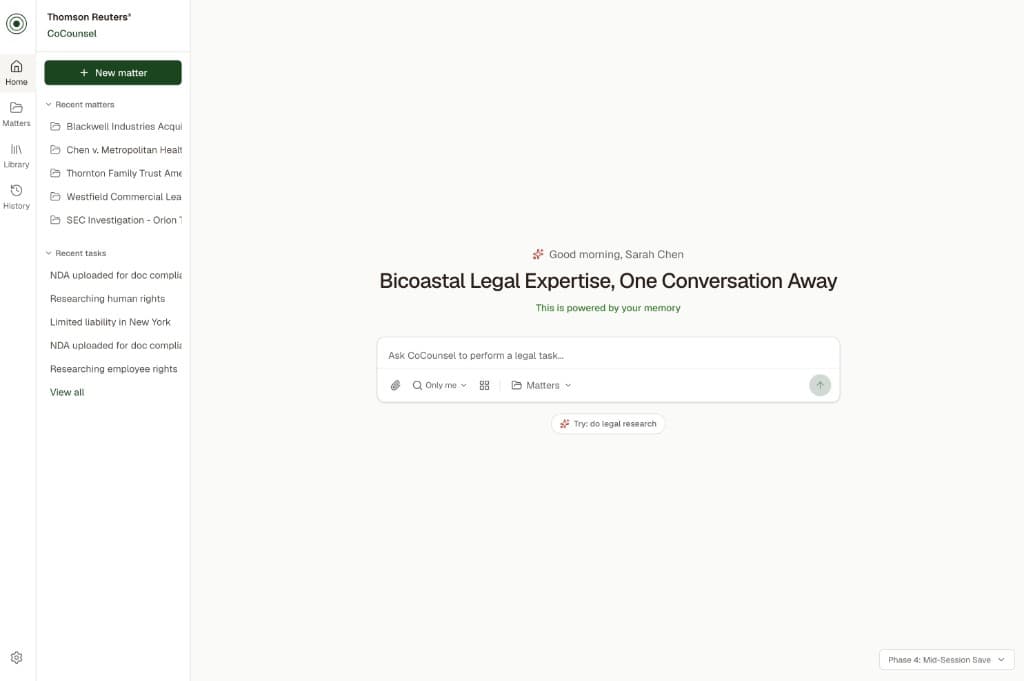
CoCounsel home with memory callout on the greeting and a prompt to try legal research—memory framed as the starting condition, not an afterthought.

01

Memory must be visible before the ask
CoCounsel home with memory callout on the greeting and a prompt to try legal research—memory framed as the starting condition, not an afterthought.

02

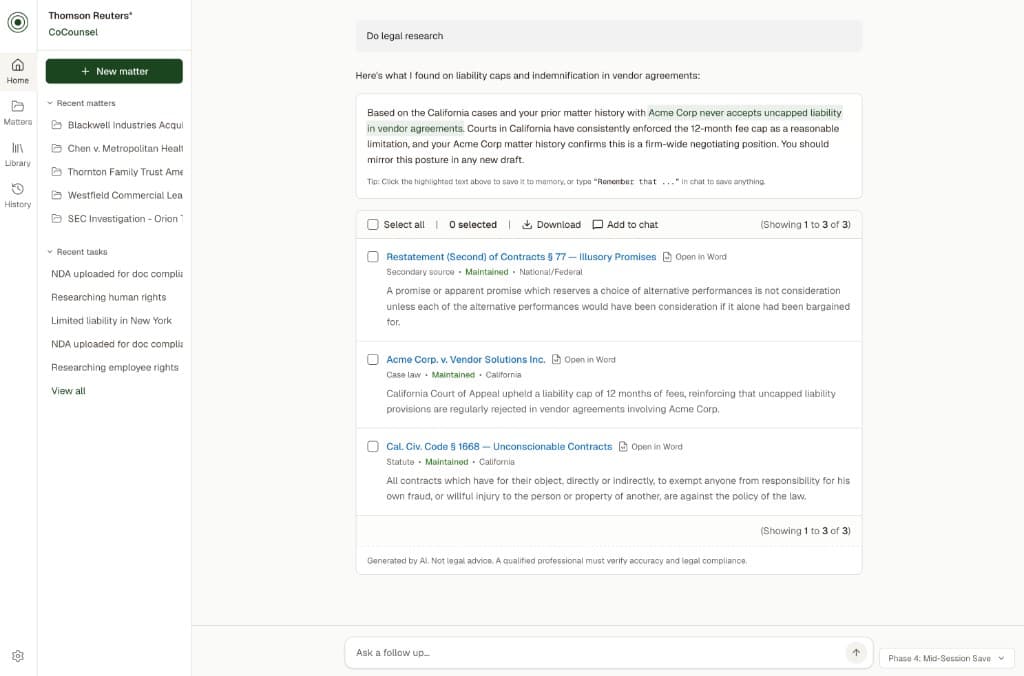
02. Capture in the flow of research

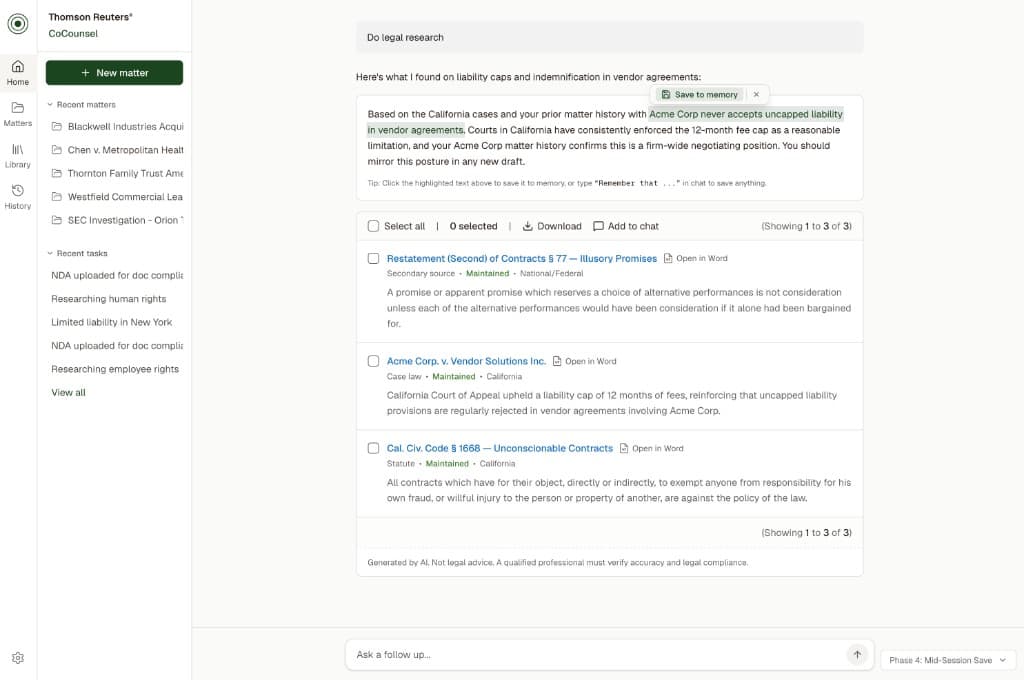
During research, answers are grounded in maintained authorities while matter history (e.g., Acme Corp liability posture) can be highlighted for save. The tip teaches two capture paths—click highlighted text or type "Remember that…"—so mid-session save feels native to how lawyers already work.

Research results with matter-history phrasing highlighted and a tip for saving to memory without leaving the task.

02

Capture in the flow of research

Research results with matter-history phrasing highlighted and a tip for saving to memory without leaving the task.
Explicit "Save to memory" affordance on the highlighted passage—capture as a deliberate human action, not silent model note-taking.

03

03. Confirm, edit, and own what was saved

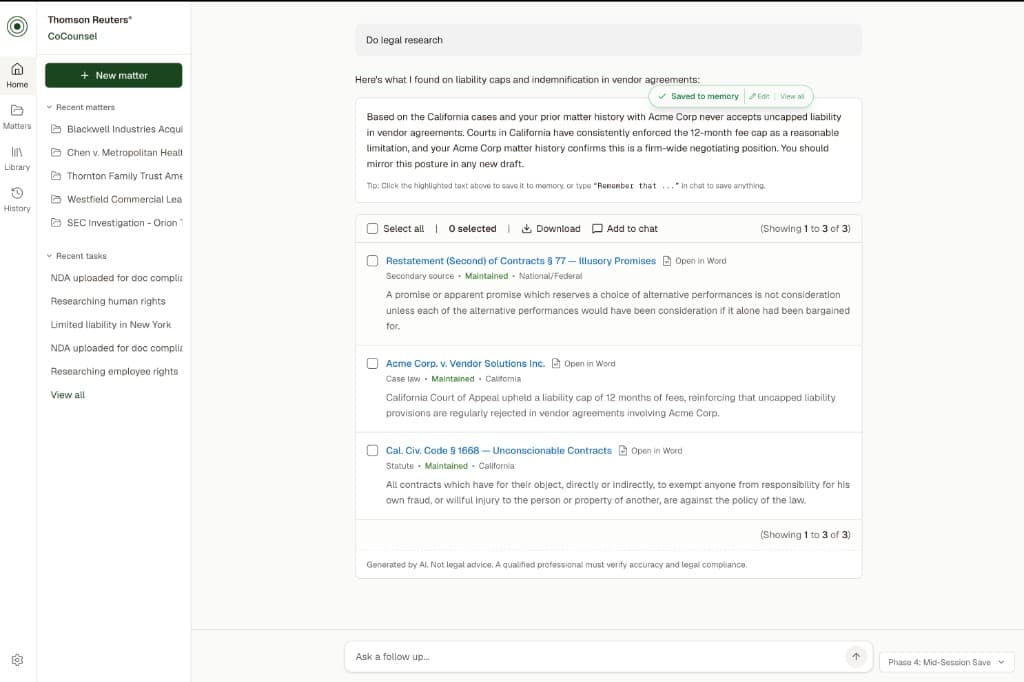
After save, the UI shows "Saved to memory" with Edit and View all. Governance requires that practitioners can see and revise what the system retained—opaque capture was one of the fiduciary failure modes we designed against.

Post-save confirmation with edit/view controls, keeping memory auditable by the person who owns the matter.

03

Confirm, edit, and own what was saved

Post-save confirmation with edit/view controls, keeping memory auditable by the person who owns the matter.

04

04. Semantic memory as curated preferences

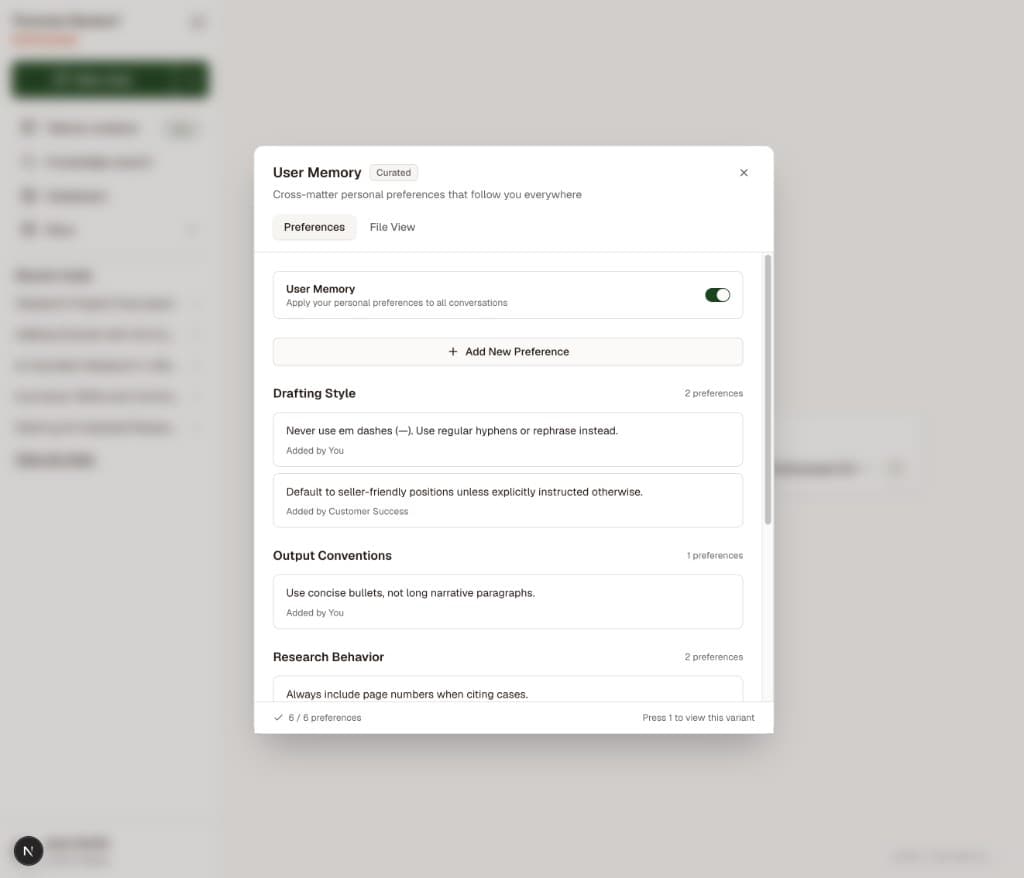
User Memory surfaces cross-matter preferences—drafting style, output conventions, research behavior—with provenance (Added by You vs Customer Success). That makes institutional rules visible and assignable to the functions that already govern legal knowledge.

User Memory preferences modal: curated cross-matter rules with clear ownership and add/edit controls.

04

Semantic memory as curated preferences

User Memory preferences modal: curated cross-matter rules with clear ownership and add/edit controls.

05

05. Precedence people can reason about

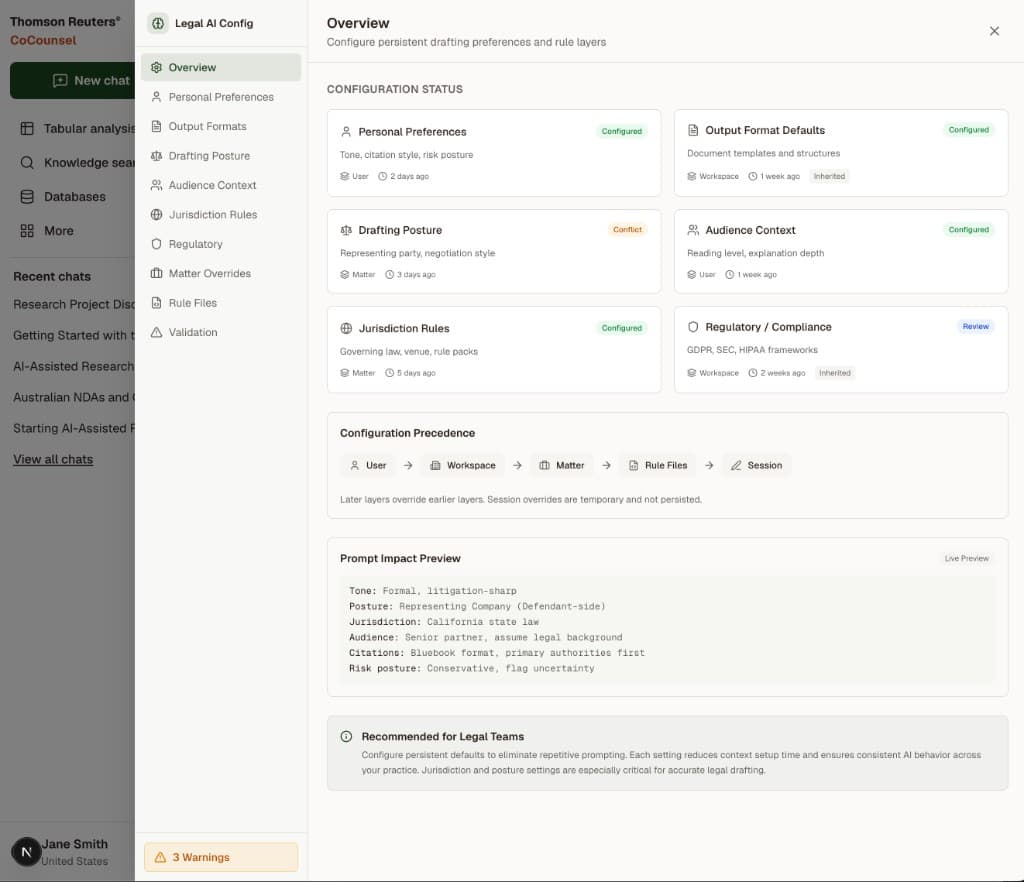
Legal AI Config shows configuration status across personal, workspace, and matter layers, plus an explicit precedence chain: User → Workspace → Matter → Rule Files → Session. Conflicts and review states surface as warnings—so override is designed, not accidental.

Overview of configuration status and precedence, with a live preview of how layers resolve into tone, posture, jurisdiction, and risk.

05

Precedence people can reason about

Overview of configuration status and precedence, with a live preview of how layers resolve into tone, posture, jurisdiction, and risk.

06

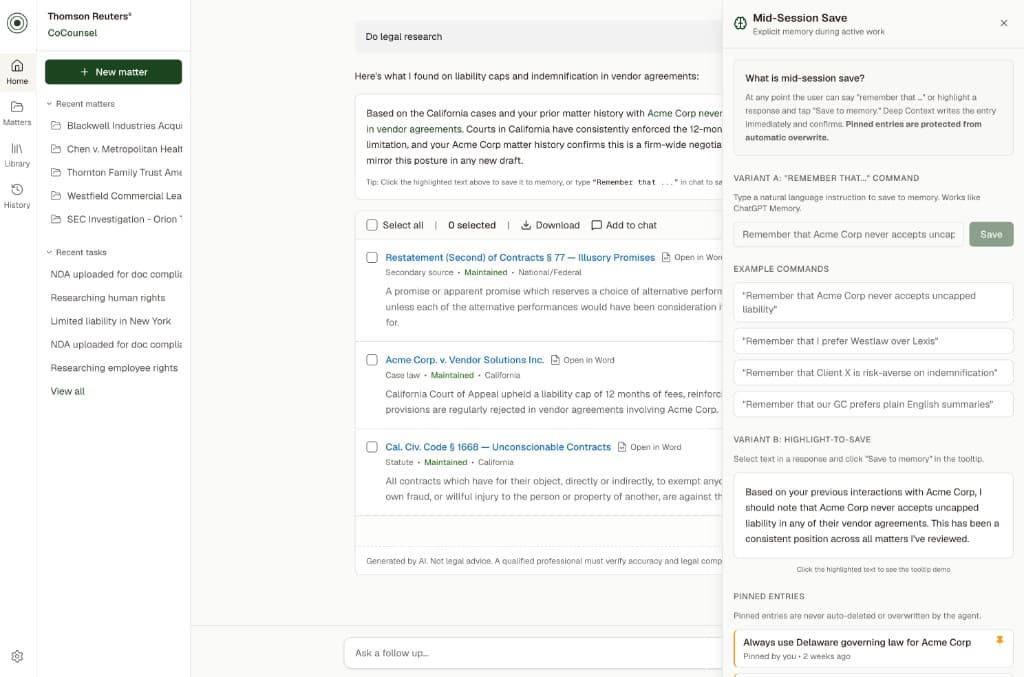
06. Two interaction models for mid-session save

Variations explored command-style capture ("Remember that…") versus highlight-to-save, plus pinned entries that resist overwrite. Eighteen explorations narrowed to patterns that keep Deep Context under human control during active work.

Mid-session save panel comparing Remember-that commands, highlight-to-save, and pinned preference entries.

06

Two interaction models for mid-session save

Mid-session save panel comparing Remember-that commands, highlight-to-save, and pinned preference entries.

07

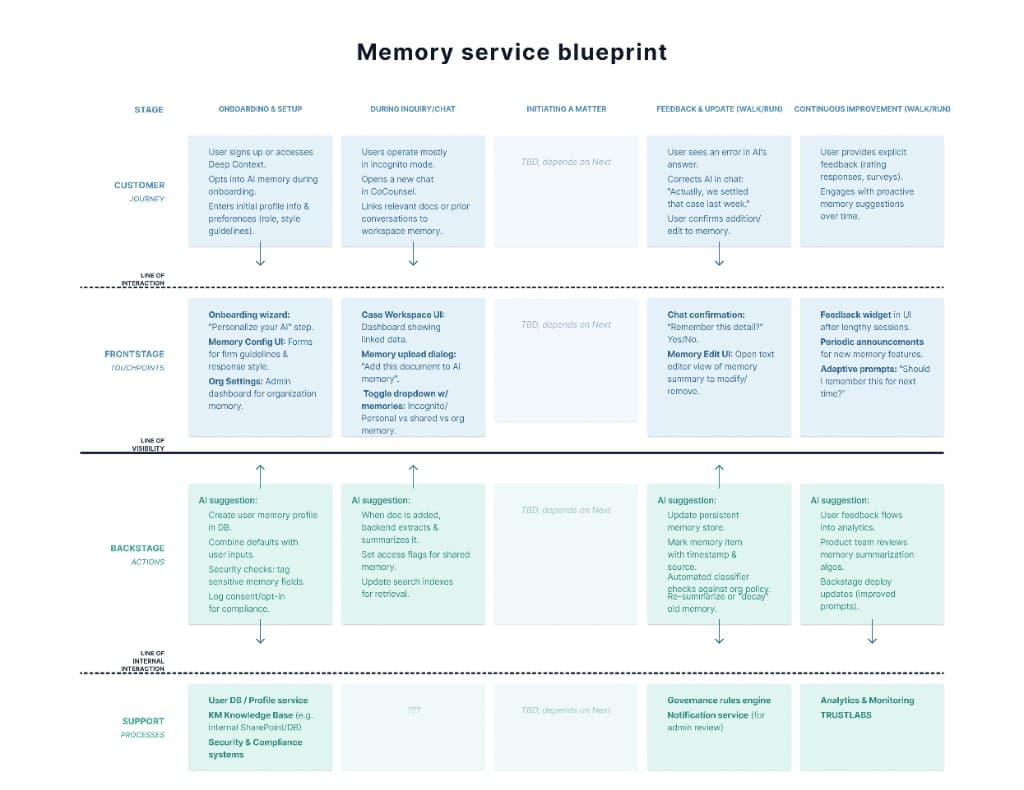
07. Systems thinking behind the UI

The memory service blueprint maps onboarding, chat, feedback, and continuous improvement across customer journey, frontstage, backstage, and support processes—including governance rules and knowledge systems. It kept design, product, and engineering aligned on what to validate each phase before committing architecture.

Memory service blueprint: stages from onboarding through continuous improvement, with frontstage and backstage layers.

07

Systems thinking behind the UI

Memory service blueprint: stages from onboarding through continuous improvement, with frontstage and backstage layers.
18
design variations explored
2
memory types defined
KM/PSL
practitioner feedback loop

Interested in the decisions behind this work?

Let's talk